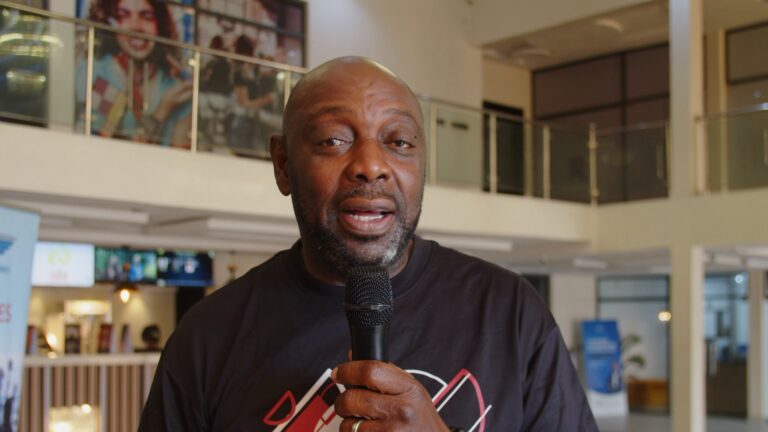
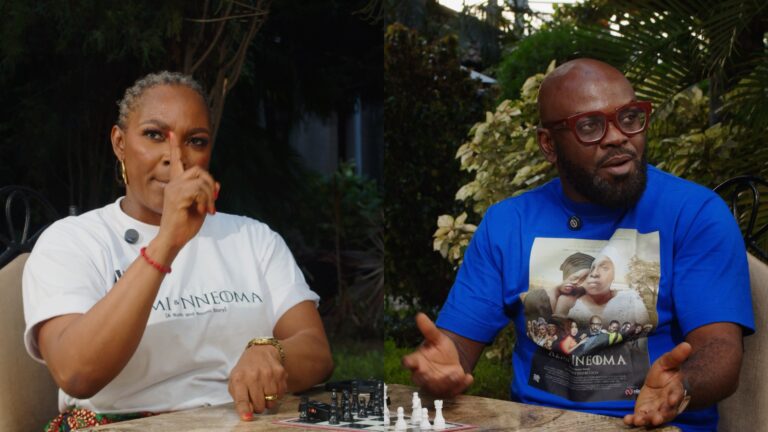
When the cast of ‘Osamede’ arrived in Benin, they didn’t expect to be tested in spirit, stamina, and speech. For William Benson, Lexan Peters, Tosin Adeyemi, Etinosa Idemudia, and Paul Obazele, the film’s demands went far beyond memorising lines.
Under James Omokwe’s direction and Lilian Olubi’s calm but determined production, the actors had to relearn a language, embody a culture, and surrender to a story that felt both ancient and divine. What began as a film shoot became a journey of transformation.
For most of the cast, William Benson, Lexan Peters, Tosin Adeyemi, Etinosa Idemudia, and Paul Obazele, speaking was the biggest challenge. “Sometimes you think you understand the language because you grew up around it,” Benson says, “but wait until you stand in front of a camera; that’s when you realise some phrases will beat you.”
Lexan Peters calls it his “panic-attack moment”. He was originally cast in a single-scene role but got a call from Omokwe days before shooting that changed everything: he was now the lead supporting role. “I went to the bathroom to pick up the call,” he recalls. “James said, ‘We want to give you Nosa.’ I froze. I was scared because I didn’t speak Benin fluently. I almost turned it down.”
He didn’t. With the help of a language coach and long nights spent repeating voice notes “like I was hearing Chinese”, Lexan learnt. “By morning, it clicked. Every word suddenly made sense.”
For Tosin Adeyemi, who is from Edo State but speaks a different dialect, the film became a lesson in rediscovery. “There are over twenty languages in Edo,” she explains. “I had to learn to speak Benin properly for the first time in my life. It was tough, but it felt like coming home.”
The cast affectionately describes Omokwe as both “mean” and “patient”. “He knows how to get you there,” says Benson. “There were times I felt uncomfortable with the lines, but James would just look at me and say, ‘No pressure. You’ll do it.’”
That phrase, “no pressure”, became a mantra on set. “He pushed us, but always with calm,” says veteran actor Paul Obazele. “Even when you thought you couldn’t get a line or a fight right, he believed you would.”
Omokwe’s commitment to authenticity went beyond performance. Every cultural detail, from the costumes to the artefacts, had to be precise. “The art director showed us archives from the 1940s and 1980s,” Etinosa recalls. “We were looking at photos of real people who lived this history. Every day I had goosebumps.”
If Omokwe was the general, executive producer Lilian Olubi was the anchor, a presence everyone on set describes as serene, prayerful, and deeply involved. “She brought peace to a project that could easily have been chaos,” says Obazele. “When things got tense, she prayed. When it was about to rain during an outdoor shoot, she said, ‘James, speak to it.’ And the sky cleared.”
Benson remembers her fondly: “She’d be on set, singing or praying under her breath. She carried the production like it was a calling, not a job.”
Etinosa, who calls Olubi her “sister”, admires her calmness and clarity. “There were issues, plenty, but never a time they weren’t resolved. Her mentality was always: what’s the solution? How can we make this work?”
For Peters, Olubi’s generosity was both emotional and material. “This was the highest I’ve ever been paid in my career,” he says quietly. “But more than that, she gave us access, care, and peace.”
If language was the mental battle, the physical one came with bruises. The cast endured stunt rehearsals and combat training under the supervision of a stunt coordinator named Frank. “There was a point I couldn’t get up from bed,” Adeyemi admits. “My body was just done.”
Lexan’s transformation was total. “They shaved my head, dusted me in brown foundation daily, and made me look like I’d lived under the sun my whole life. Every day, I took two baths: one to wash off makeup, the other to wash off sand.”
Even veteran Obazele, who watched most of the fight scenes from the sidelines, says he couldn’t believe their endurance. “They were dragging, rolling, and fighting in real heat. You could tell it wasn’t acting. It was survival.”
Underneath the exhaustion, though, was a collective sense of reclaiming Benin storytelling. “If we don’t tell our stories”, Benson says, “others will tell them the way they like. ‘Osamede’ is for us, by us.”
The production also involved locals from Fugar and surrounding communities, who served as extras and stand-ins. “The villagers became part of the story,” Lexan says. “It wasn’t just filmmaking; it was community building.”
By the time shooting wrapped, the cast had become bonded by language, sweat, and prayer. “I started scared,” Lexan admits, “but I left proud. Proud of my heritage, proud of this story.” Or as Obazele puts it, “We didn’t just act in Osamede; we lived it.”
As ‘Osamede’ continues its theatrical run, that pride now extends to audiences discovering the film for the first time.