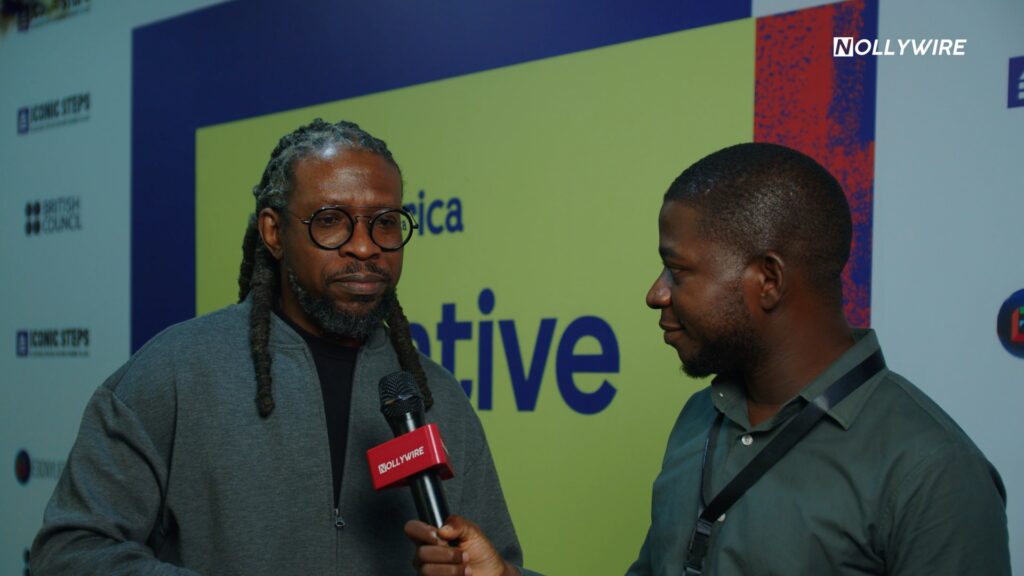
At Film Lab Africa: Creative Hustle, filmmaker and production executive Victor Sanchez Aghahowa offered a candid look into how projects are evaluated and why many fail before they even begin.
Speaking after a panel conversation with producer Uche Ikejimba and director Kayode Kasum on positioning creatives for the future, Sanchez, who currently serves as Head of Production, West Africa at MultiChoice, drew from decades of experience across film and television, including reviewing what he estimates to be over a thousand pitches annually.
“It’s hard to quantify,” he said, when asked how many projects cross his desk each year. “But if you combine everything from MultiChoice, direct pitches, and consulting, it’s more than a thousand.”
Despite the volume, Sanchez was careful not to frame the process as judgement. Instead, he pointed to a recurring pattern that undermines otherwise promising ideas: overdevelopment at the earliest stage.
“The most common mistake I see is people thinking that more detail will help their pitch,” he said. “A lot of the pitches are overdone; they’re overcooked. If you’re pitching, I don’t need seven pages of your set design. We’re not there yet.”
Sanchez added that the priority is clarity. A strong pitch, he argued, should communicate the core idea of a project leaving room for development rather than attempting to resolve every detail upfront.
“Give me the core of what the project is,” he said. “We can always build out from there.”
Beyond pitching, Sanchez also addressed a broader issue shaping the next generation of creatives: access to knowledge. Rejecting the notion that formal education is a prerequisite, he described the internet as his own film school.
“I didn’t go to film school,” he said. “I don’t have a degree. The internet is the most powerful resource we have, and we carry it in our pockets 24/7.”
However, he suggested that access alone is not enough. With the rise of AI tools and an abundance of online resources, expectations within the industry are shifting.
“It’s getting easier to get information,” he noted. “It doesn’t make it easier to make [films], but it makes it easier to learn. So executives are going to be a little more unforgiving in the next five to ten years. What’s your excuse if you don’t know?”
His comments reflect a growing recalibration within the industry, where barriers to entry are lowering, but standards are rising in parallel. For emerging storytellers, the implication is clear: preparation, research, and clarity of vision are no longer optional.
Sanchez complements a wider conversation at Film Lab Africa about what it takes to succeed in a rapidly evolving media landscape. While talent remains a baseline requirement, the ability to articulate ideas effectively and to do the foundational work behind them may ultimately determine which projects move forward.