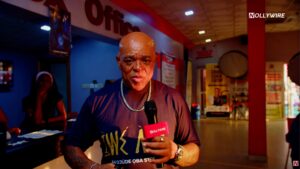
Before Olatunji Afolayan became one of Nollywood’s most respected art directors, he was just a boy in Ilorin, Kwara State. After primary school, he moved to Osun State to live with his uncle, who soon discovered he had a talent for art. Afolayan attended secondary school in Ijebu Jesha, where his artistic curiosity continued to grow. During school holidays in the early ’90s, while his friends spent their time playing, he apprenticed with a local artist—one of those men who could paint anything by hand before the digital era arrived. “It wasn’t even called graphic design back then,” he recalls, laughing. “We used manual brushes and paint. By the time I was in secondary school, I was already doing signboards for people, for free, just for the love of it.”
Years later, while studying Mass Communication, destiny rerouted him. For his industrial training, he found himself at Mainframe Productions—Tunde Kelani’s legendary outfit—where a question from Kelani changed everything. “He asked what else I could do apart from school, and I said, ‘I’m an artist.’ He said, ‘Ah, you’ll be good in the art department.’ That was it.”
At Mainframe, Afolayan trained under veterans like the late Pat Nebo and Kehinde Oyedepo Kosmac, learning the language of film and how art meets camera. “You have to understand the camera before you can design for it,” he says. “Everything you do as an art director is for the camera.” From painting signboards to sketching sets, from dressing scenes to designing worlds, Afolayan found his calling in the space between imagination and structure.
Today, with over two decades of experience spanning projects like ‘Amina’, ‘King of Boys: The Return of the King’, ‘Battle on Buka Street’, ‘Seven Doors’ and ‘Jagun Jagun’, Olatunji Afolayan has witnessed Nollywood’s transformation up close, from the days when producers didn’t understand what an art director did to a present where world-building defines the industry’s biggest exports.
In this Off Camera conversation, Olatunji Afolayan talks about the evolution of art direction in Nollywood, the problem-solving born from lean budgets, the delicate balance between authenticity and invention, and the tenacity it takes to keep building worlds even with a broken leg.
You’ve spent over two decades in Nollywood, watching the industry grow from low-budget productions to globally streamed blockbusters. Looking back, how would you describe the journey of art direction in that evolution?
It has evolved, really evolved. When I started in the early 2000s, mid-2000s, being an art director was mostly driven by passion and skill. Then, if you were not an artist, you couldn’t be an art director. Now, things are different. Today, anyone can go online, learn a few things, and apply them, but back then, you needed to truly understand the craft.
For me, an art director is that person who plays the role of God in filmmaking. You breathe life into text written by a writer. The director brings it alive through you, the cinematographer gives it life technically, but you, as an art director, interpret it visually. You think about colour, composition, depth, and texture; you build the world the audience will believe.
In the early days, producers didn’t even understand what we did. They’d ask, “What is this guy doing?” and sometimes think we were just being given work for the sake of it. Many didn’t see art direction as integral. But today, people understand that production design defines the look and feel of a film. We now have awards for Best Art Director and Best Production Designer. That recognition didn’t exist before.
The industry has grown. Now, many productions can run at the same time without clashing. People know the importance of art direction, and that’s a huge change. Back then, it was hard to even explain your relevance on set. So yes, it’s evolved a lot.
Filmmaking is often described as a director’s medium, but some argue art direction is the backbone of cinema, the part that makes belief possible. For you, what is the essence of art direction, and why is it indispensable to storytelling?
Like I said, filmmaking is an interpretation of text into visual representation. The art director is the person responsible for creating that visual world. There are three main elements that give a film its look and feel: the director, the director of photography, and the art director.
The director leads the artistic, technical, and human sides of filmmaking. The DOP handles the technical picture. The art director handles the visual and spatial interpretation, the physical look of the world. We work hand in hand. There shouldn’t be any competition between a film director and an art director because both roles are crucial to making a film believable. If the three directors – the art director and the cinematographer – work together in sync, you’ll always have a beautiful film.
When a script lands on your desk, what’s the first thing you look for? How do you begin to imagine the spaces, textures, and moods that will eventually live on screen?
There’s no fixed approach. Every script comes with its own world, and my process depends on what the story demands. When I read a script, I start building the world in my head immediately. The script is the blueprint. If I fall in love with the story, then I’m already inside it. As I read, I’m developing the textures, the atmosphere, the colours, everything.
One important thing for an art director is retentive memory. Everything you’ve seen or experienced in life becomes part of your creative vocabulary. When you read a script, you’re building an imaginary world but you can’t do that in isolation. You draw from what you’ve seen, felt, or experienced.
After I’ve formed the world in my head, I put it down visually. Then it goes to the director for approval. Once the director signs off, I share it with the set designer, props master, and costume designer. Together, we start building that world that never existed.
It takes full dedication. I once lectured briefly in a mass communication department but had to resign because this job needs all of you. Art direction is not a side hustle; it demands your full presence, your body and mind.
Nollywood is producing a wave of epic films rooted in mythology and history. How do you approach the challenge of designing those worlds so they feel authentic yet also visually captivating for modern audiences?
Don’t be surprised; more are still coming. I call it a paradigm shift in filmmaking. Sometimes the direction of the industry just shifts. When I worked on ‘Jagun Jagun’, for example, the first thing I told the producer was, “Are we good to do our own gladiators?” And he said yes. That gave me a clue about the world we were about to build.
We were telling an African story for a global audience, so the challenge was to make it visually appealing to both local and international viewers. You’re showing a world that existed maybe 100 or 200 years ago, something we didn’t witness but you want people to feel it’s real.
Film is a global language, so even if the story is Yoruba, the visual language should communicate universally. When creating ‘Jagun Jagun’, we imagined: if Africa had an arena, what would it look like? We drew inspiration from gladiator stories but built it around what would have existed in Yoruba land.
It’s about balancing authenticity with creativity. You design a world that feels true but also connects emotionally with people everywhere.
You’ve worked across very different genres, from the political drama of ‘King of Boys: The Return of the King’ to the mythologic ‘Jagun Jagun’. How do you shift gears between those worlds, and what connects your approach across them?
It all starts with the story. Whether it’s contemporary or epic, I approach each one as a new world that needs to be built from the ground up. What connects them is the intention to make the audience believe. When we did ‘King of Boys’, people called me “the king of contemporary”. After ‘Jagun Jagun’, they started calling me “the king of epic” too. Then ‘Seven Doors’ came and i was referred to as “the kind of vintage” I just think it’s about giving each story the best possible visual life it can have.
What’s the hardest part of translating Nigeria’s diverse cultures; our architecture, aesthetics, and traditions, onto the screen without resorting to stereotypes?
I don’t see it as hard, really. What matters is paying attention to detail. Every story has a base and a background; it’s rooted somewhere. You just need to understand that context.
Ask yourself simple questions: is this character Christian or Muslim? What region or culture does this story belong to? Once you define that, you know what cultural world you’re building. You research properly and stay within that world.
When we worked on Amina, which earned me an AMVCA, (I’m not Hausa), we told that story authentically because we respected its context: the Zazzau Kingdom. If you stay true to your story’s background, you won’t get confused or rely on stereotypes. You can’t tell everybody’s story in one film. Choose one and tell it well.
Many Nollywood productions still battle with lean budgets and timelines. What are some of the creative problem-solving techniques you’ve had to develop to still deliver world-class set design?
That’s a general problem; it affects everyone, from screenwriters to cinematographers. But it’s not new. From the beginning, filmmaking in Nigeria was communal, not commercial. People came together because of passion, not money.
I remember when we shot Efunsetan Aniwura in Ibadan. The production manager went around the village begging people to let us use their houses. Crew members slept in strangers’ rooms. People stayed on set for a month just to be part of the crowd scenes. That’s the spirit the industry was built on.
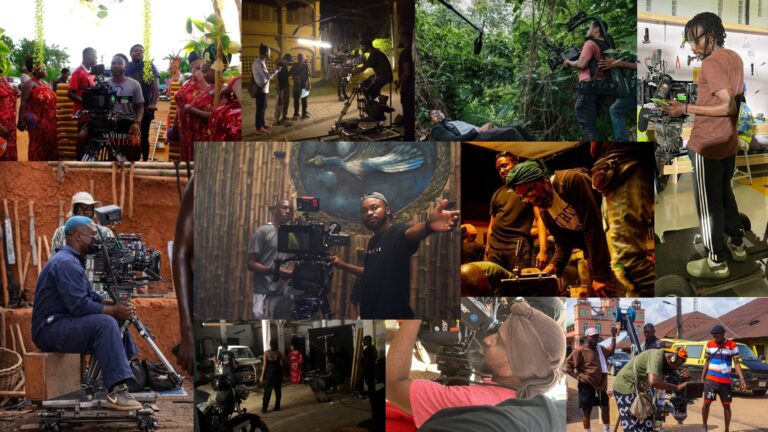
So, when people talk about low budgets, I just smile. We’ve always worked with little or nothing. Back then, we’d cut wood ourselves, tie things with rope, and build sets from scratch. That resourcefulness shaped us. A big budget doesn’t necessarily make you a better art director. You must be able to create something out of nothing. That’s the true art of it.
Beyond creating sets, art direction also influences how Nigeria is imagined globally. Do you think Nollywood’s design choices are reshaping the country’s cultural identity on screen?
Yes—absolutely yes. We even have a group now advocating for accurate representation of Nigeria in film. We want to show our stories properly, especially in epics. Sometimes you’ll see exaggerated depictions in older films, things that might not have existed but look good visually. That’s fine if it helps people imagine the world.
Look at Korean or Japanese epics: many of those aesthetics are creative choices, not historical facts. But they’ve shaped how we see their culture. It’s the same for us. We need to create our own visual language. If we show our kingdoms, our palaces and our streets in a new way, the world will start to see us differently.
I hate when Western films introduce Africa with monkeys or savannahs; it’s insulting. That’s not who we are. Through art direction, we can correct that image. The way you design a space is how people will perceive your culture. Like they say, dress the way you want to be addressed. We’re already changing that narrative, but we’ll keep pushing until the world fully sees that we’ve come of age.
For younger artists who want to follow your path, what do you think they still don’t understand about art direction’s power? And what’s one thing you’d want them to carry into the future of Nollywood?
They need to understand resilience. This job won’t pamper you. You’ll face discouragement, lack of respect, long hours, and exhaustion, but you must keep going. Everything on set is built to frustrate you, but you can’t give up. If you’re petty, don’t come into art direction. If you can’t get dirty, roll up your sleeves, or work with your hands, it’s not for you. You must be strong, physically and mentally. It’s not a job for people who want to stay neat or be treated delicately.
Let me give you an example. When we were filming ‘King of Boys’, I had already injured my left ankle on a previous set and had a POP on it. Even with that, I was still working. The leg never healed completely; it took four or five years before the pain stopped.
There was a day on ‘King of Boys’ when the set was particularly strenuous. Kemi Adetiba was happy because we managed to deliver a very difficult scene despite the odds. The next morning, my leg was so bad I couldn’t get out of bed. I called for medics to come to my hotel room, and when Kemi saw the message, she was shocked. She told everyone, “If Tunji is calling for medics, something is really wrong.”
She asked me to stay back at the hotel for the day and take much needed rest but I insisted I had to go, they were marveled to see me on set at Ijora same day limping but working . Her love for me skyrocketed and the outcome was a successful film. That’s how relentless you have to be in this work. You can’t expect to be pampered. You just keep going because the film must be made. So yes, you need to be 75% physically strong and 25% mentally strong or maybe even the other way around. Either way, you need both.
For the future, I hope young art directors push for better recognition. We need to be treated as professionals, as human beings. Sometimes, our department doesn’t even get rest days when others do. I’ve worked on shoots where I never even slept in my hotel room; it was just wasted.
We need a new direction for art direction: better treatment and more understanding of what we do. The next generation should make sure that happens.