When a story already lives in people’s heads, adaptation becomes something else entirely and that weight is unavoidable for Lola Shoneyin’s ‘The Secret Lives of Baba Segi’s Wives’.
Before audiences experience the upcoming screen version helmed by Daniel Oriahi, the story has moved across pages and stages, been performed in different cities, studied, debated, and translated into six languages. It has become one of the most recognisable portraits of polygamy, domestic rivalry, and social hierarchy.
That familiarity is what makes the film’s translation delicate.
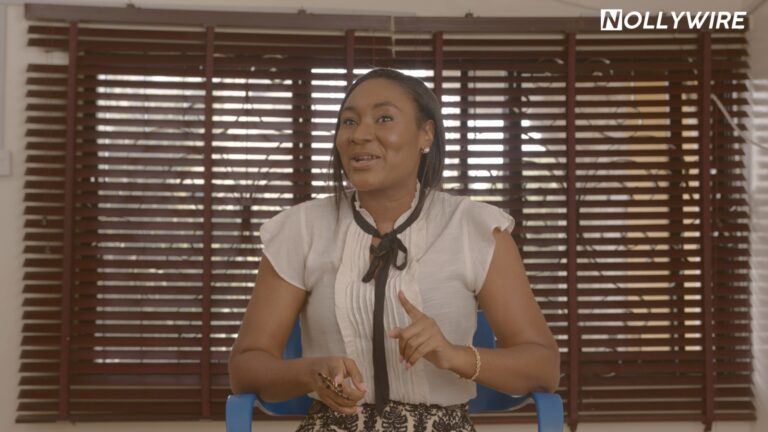
Costume designer Yolanda Okereke says it’s what makes it matter.
“It’s very sacred,” she says. “It’s not a new material. It’s something a lot of people are familiar with… a book that is iconic for telling an authentic story.”
In that sense, her role isn’t just to dress the characters in the larger-than-life production from Mo Abudu’s EbonyLife Films, in partnership with Genesis Group, Nile Group, and Silverbird Group; it’s to interpret them for an audience that thinks it already knows them and those meeting them for the first time.
At the centre of the story is Baba Segi, his four wives, and a household defined by hierarchy.
In her conversation with Nollywire, Okereke shared her appreciation for literary adaptations, saying that the best stories are adapted from books. And ‘The Secret Lives of Baba Segi’s Wives’ arrives with detailed source material.
The novel’s vivid descriptions of its characters give her the foundation to begin her interpretation with difference.
“We’re all a product of our environment,” she explains. “What kind of home are you coming from? How you were brought up… determines what you’re going to be like as an adult.”
Each wife comes from a distinct background, shaped by upbringing and class. Costume, then, becomes the first layer of storytelling.
Before dialogue, the audience must be able to read each woman clearly.
Who is restrained?
Who is expressive?
Who signals affluence and who performs it?
These are questions that must be answered visually.
Okereke, whose eye for character-driven styling has been evident across projects, looks to build individuality into the fabric of the film. What each character wears at home versus in public, how they present themselves, and how they shift depending on who they’re around all become cues to their inner lives.
But Baba Segi’s Wives is built as much on tension as it is on difference.
“When you have four wives in a compound, there’s going to be a lot of fights… a lot of contention.”
Okereke leans into the drama, using costume not just to separate characters but to underline the tensions and familiar dynamics between them.
The hierarchy between wives, the unspoken competition, and the jealousy that simmers (especially between those closest in rank) are all part of the story’s emotional architecture.
She keeps specific details back for now. “I can’t give out so much… there will be nothing to look forward to on the screen.”
Still, the scale of the project is clear.
With a cast that includes Odunlade Adekola, Omowunmi Dada, Iyabo Ojo, Mercy Aigbe, and Bimbo Ademoye, the film adds another layer to how characters are read by bringing together actors with strong screen identities.
That adds another layer to the work.
The costume must go beyond defining a character to align with, and sometimes reshape, how audiences already perceive these actors.
It’s part of what makes the project, in Okereke’s words, “the kind of material that you pray for”.
‘The Secret Lives of Baba Segi’s Wives’ falls into a category of projects that come with both recognition and responsibility, one that will ultimately play out on screen in December 2026.