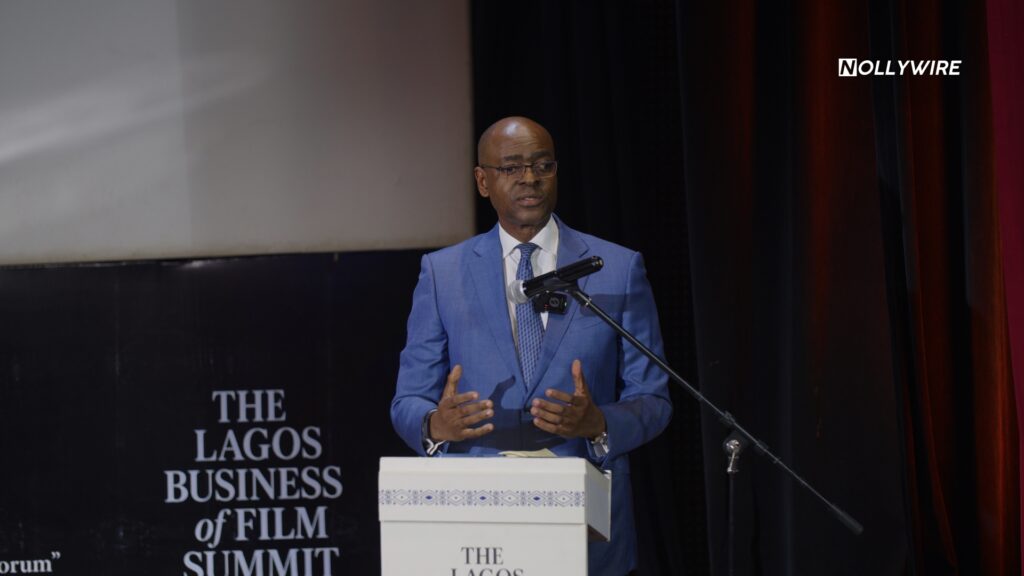
At the Lagos Business of Film Summit, the conversation around Nollywood’s growth turned from ambition to architecture as Bolaji Balogun, CEO of Chapel Hill Denham, took the stage to interrogate a long-standing fault line in the industry: financing that is sustainable, structured, and capable of delivering returns.
Rather than speaking in abstractions, Balogun anchored his keynote on Financing Film Projects: Structure, Access, and ROI in a concrete example. He cited ‘Gingerrr’, a film project Chapel Hill Denham invested in in May 2025 and has since fully recouped, positioning it as evidence of what becomes possible when creative projects meet financial discipline. For Balogun, proof, not passion, is the industry’s most persuasive currency. “Evidence is really fundamental, and evidence is needed for financing,” he said. “We must create success and tell success stories.”
That insistence on demonstrable returns framed the rest of his argument. While Nollywood is often celebrated for its scale and cultural reach, Balogun suggested that its next phase of growth depends on translating cultural power into investor confidence. Capital, he argued, responds less to sentiment than to data, track records, and repeatable outcomes.
Placing Nollywood within a wider economic and demographic lens, Balogun underscored why the creative industry matters beyond entertainment. With projections indicating that Africa could account for one-third of the world’s population in the coming decades, he positioned Nollywood as both a cultural export and a strategic economic asset. “Nollywood matters because you tell our stories,” he said. “The world does not know our stories, and it is important that we tell them. When we do, people will understand us, and they will want to invest.”
That global relevance, however, will not translate into capital without structure. Balogun projected that Nigeria’s creative sector could contribute between 20 and 30 percent of GDP over the next two to three decades but only if the industry is formalised and aligned with investment-ready standards. In his telling, the challenge is not a lack of creativity but a gap between how films are made and how institutional capital assesses risk.
Collaboration emerged as a recurring theme. Invoking Liverpool Football Club’s anthem, “You’ll Never Walk Alone”, Balogun stressed that neither filmmakers nor financiers can shoulder the industry’s ambitions independently. “None of us can do it alone,” he declared. “None of us individually has the capital or the courage to do it alone.” For Nollywood to attract global investors, partnerships across production, distribution, finance, and infrastructure are not optional; they are foundational.
He also turned attention to the role of government, pointing to markets such as South Africa, Ghana, and Morocco, where tax incentives have helped catalyse creative production. Similar policy frameworks in Nigeria, he argued, could materially improve the operating environment for filmmakers while reducing risk for investors.
Beyond capital and policy, Balogun warned that growth without infrastructure would stall. Engaging infrastructure investors across studios, cinemas, distribution networks, and post-production facilities is critical if Nollywood is to serve a future audience measured in hundreds of millions. “To serve a projected population of 500 million people, the scale of investment required is enormous,” he said. “That level of funding can only come through collaboration.”
In closing, Balogun widened the lens to include talent management, capacity building, and the digitisation of Nigeria’s historical content as key enablers of long-term value. But he returned, ultimately, to first principles: evidence, data, and repeatable returns. Without them, the industry’s promise remains aspirational. With them, Nollywood becomes legible to capital and capable of delivering the multiples investors seek.